
2026 Transfiguration Sunday
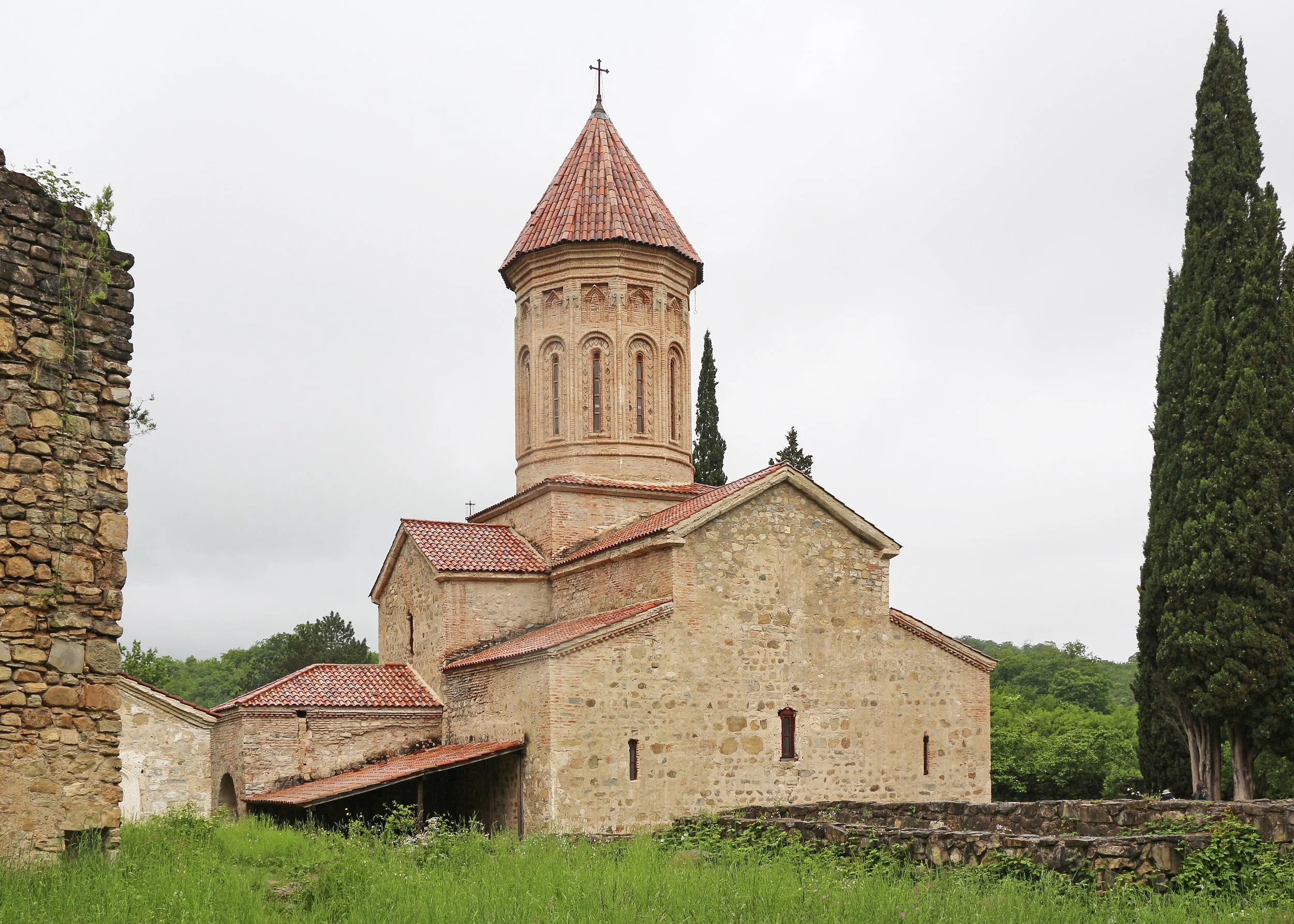
Church of the Transfiguration, Ikalto Monastery, Georgia (the country not the state); photograph by Bernard Gagnon made available on Wikimedia Commons
Sunday is Transfiguration Sunday. I began writing the sermon below and then realized, I can't actually preach it in a local congregation as the prime example is of congregations who have moved locations and if I preached this while standing in a literal congregational building, it would imply that "the Regional Minister thinks we ought to sell our building and move." Side Note: The Regional Minister does in fact believe that some congregations should at least consider selling their building and moving. However, I can't imagine being that directive in sermon. Sermons are generally linear experiences and suggestions like that should be conversational with lots of room for push back, questions, outrage, and listening all around. A blog is a better space for this reflection.
Is your faith formed around a monument or committed to movement? The desire to make monuments out of significant events is human even biblical. In Matthew 17, we bear witness to a significant event in the ministry of Jesus. The presence of Moses and Elijah represent the fulfillment of ancient prophecies (see Deuteronomy 18:15; Malachi 4:5-6). In Moses and Elijah we have the covenants of law and of life; the Torah and Prophets. This was a significant moment in Jesus Ministry.
People made monuments for significant moments. Noah (Genesis 8:20) after the flood; Joshua at the crossing of the Jordan (Joshua 3-4). David imagining the Temple (2 Samuel 7:2). Peter did not give an intuitively wrong answer. He only appears wrong after we have heard the voice from the cloud. Still, monuments have purposes.
What are the monuments of our shared life together? Physical structures: campgrounds, church buildings, positions and people. Perhaps they are patterns, traditions, or unexamined beliefs. I think about all the dated or dysfunctional furniture on our buildings that we cannot throw out because of who gave it to us. Yet as I have learned repeatedly as Regional Minister, monument-dependent faith can be disrupted by circumstances beyond our control (hurricanes, freezes, mass shootings, pandemics).
Context matters. Matthew says that the transfiguration occurred six days after Peter's good confession (Mt. 16:16) but also after Peter's attempt to scold Jesus for predicting the necessity of Jesus's own death (Matthew 16:22). It had been six days since Jesus told them that following him would mean denying themselves, taking up their cross, and following him (Matthew 16:24).
Peter, James, and John are often treated as a kind of inner circle. In Mark, they are named together at the healing of Jairus’s daughter and in Gethsemane. In Matthew, this is the only time these three are singled out as having this more intimate connection with Jesus. Jesus, Peter, James, and John go to the mountain.
Matthew does not name the mountain. The silence about the place may be intentional as this is not about a shrine, but about a moment on the way. Moses and Elijah both had transcendent encounters with God on mountains. The setting is meant to signal significance. Moses the giver of the law; Elijah the ultimate prophet--they represent the Word of God (Law and Prophets).
Jesus also glows. Matthew presents Jesus as the culmination of the Law and Prophets not their refutation. His face shone like the sun, and his clothes became dazzling white. It was a moment of overwhelming holiness. Peter’s instinct toward monument took over. “Lord, it is good for us to be here. If you wish, I will make three dwellings here—one for you, one for Elijah, and one for Moses.” This moment is so good, let’s make it permanent. Let’s build monuments and let's stay here. Let's capture the glory and settle into it, rather than letting the glory draw him into the movement of following Jesus toward the cross and toward mission.
The voice from the cloud directed the disciples: “This is my Son, the Beloved; with him I am well pleased. Listen to him.” (Matthew 17:5). The mountain is not the destination. The mountain is a moment of revelation that leads into the movement of discipleship down the mountain, toward the cross, and toward the places where faith is not just about seeing glory, but about moving mountains (see Matthew 17:20).
As members of the Christian Church (Disciples of Christ) our identity statement says, “We are Disciples of Christ, a movement for wholeness in a fragmented world.” As Regional staff we have witnessed and in some ways journeyed alongside a few congregations who have literally moved locations. Not enough to claim that we are experts, but certainly enough to see some trends.
For some this has been life-giving. They have found capacity to reach new people, discover new points of connection, revitalized and gained new orientation. In other places, it has been a harbinger of the end. In my experience, there are three determining factors that are critical to whether the move is successful. 1. Repeatedly narrating a future story that says in effect, "God is leading us not leaving us." They did not frame the move as retreat; they framed it as transition. They kept telling the story; “God is not abandoning us; we are accompanying God.” 2. Internalizing the belief that they are not moving to get away from a monument that they can no longer maintain and moving to be a movement. They were willing to release the structure in order to embrace the journey of Discipleship. They believe that a future shaped by God’s vision is better than any structure of brick and mortar. 3. Relational capacity within the congregation that says, the building is not the Church; we are--us together. Not moving away but moving toward AND not scattering away from one another but growing closer fellowship.
And these lessons aren't just relevant to churches that are selling their current properties but for all of us, because what we see in this: the a future story built in the awareness of God's on going presence (O God, our help in ages past; our hope for years to come); the vision of releasing what was in order to enter into what will be; and a devotion to one another as the people of God for whatever location they inhabit. This is the living embodiment of the three eternal gifts of faith, hope, and love.